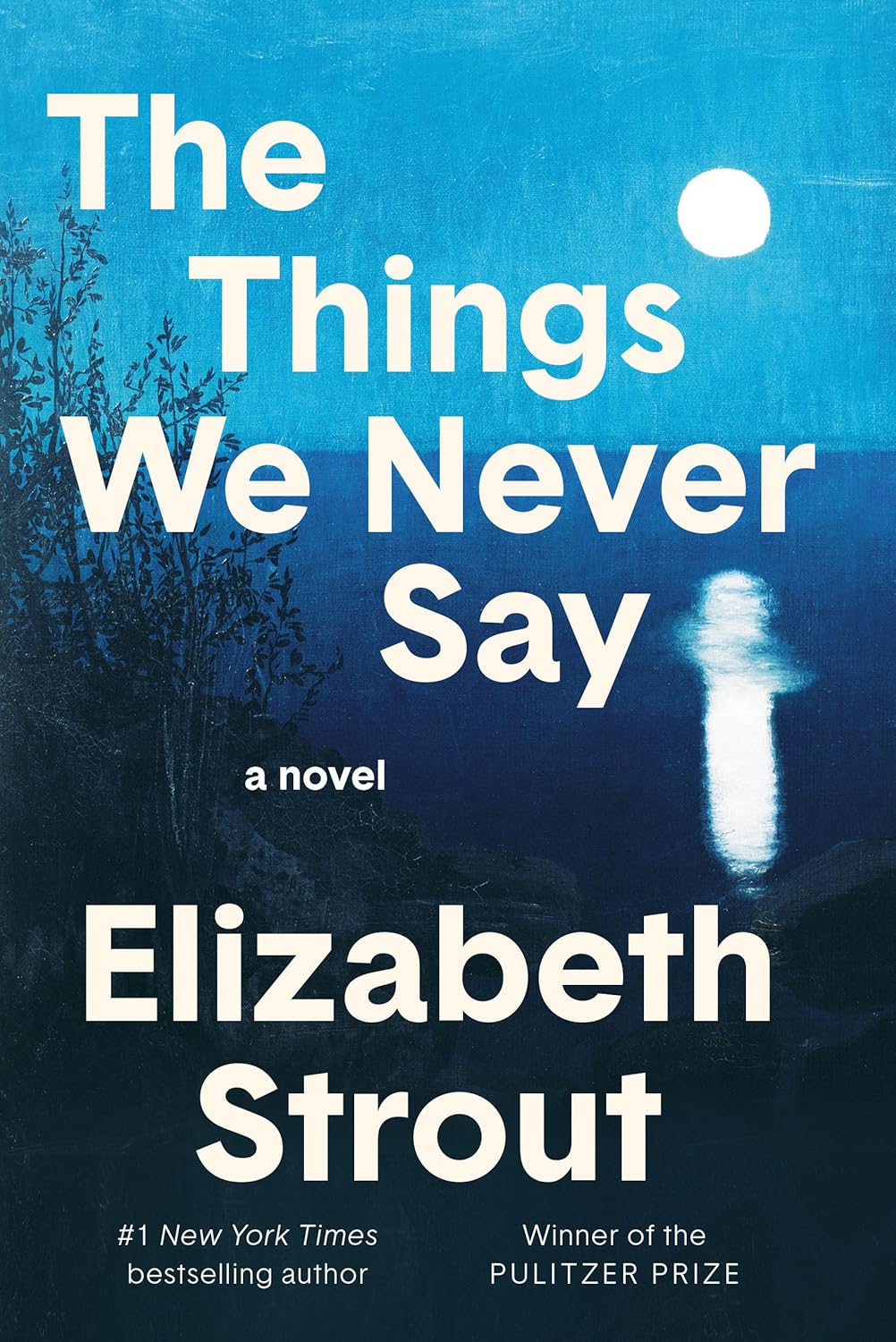
The Things We Never Say
The Things We Never Say ~ Elizabeth Strout
Loneliness does not come from having no people around you. Instead, it stems from being unable to communicate the things that seem important to you, or from holding certain views that others find inadmissible. ~ Carl Jung
This is the epigraph of Elizabeth Strout’s The Things We Never Say, and it perfectly encapsulates the novel.
Artie Dam is depressed. He is a middle-aged high school History teacher in Massachusetts with a love for sailing. His best friend, Flossie, has moved away to be closer to her daughter after the death of her husband, Reginald, whom she describes as an asshole whom she misses very much. The loss of Flossie is huge, because with her, Artie felt like he could be truly himself, in a way that he cannot at home. He is struggling to connect with his wife, Evie, and their adult son, Rob. Rob was involved in a car accident several years ago that has deeply changed the family dynamics. Artie struggles with deep loneliness and isolation, while struggling with existential questions of free will. He is considering suicide, but wants to be sure it appears to be an accident.
As with every Elizabeth Strout book I have read, this is a book of quiet desperation and a search for human connection and meaning. As secrets come to become known, the characters pivot toward and away from one another in ways that are touching, sad, and joyous in their own ways.
I loved this book, though the absolutely perfect ending is deeply sad. I listened to the audiobook, then immediately listened to it again. Highly recommended.
Tiny side note, I liked the tiny nod to one of Strout’s more popular characters/books Olive Kitterage, which is mentioned obliquely as a book a character loved about a grumpy woman in Maine. So many of her books take place in the same universe, and this mention lets us know that The Things We Never Say does not. These characters are not going to wind up visiting Crosby, Maine.


14 Comments
Margaret
I’ve loved everything Strout has written (that I’ve read anyway); her style is so human and moving. The characters feel real.
J
Absolutely! I love her.
Jenny
Oh boy. This sounds SO GOOD. I haven’t read anything by Strout, but I want to. I’m torn about this one, at least right now… I don’t know if I’m up for a deeply sad ending? We’ll see.
J
She is such an amazing writer but not light and airy. I think you would love any of her books (though her Olive Kitterage books are not as high in my esteem as this one, or her Lucy Barton books).
Nicole MacPherson
I loved this book so so so much!!! And I also loved the nod to Olive. Ahhhh what a beautiful book. I’m glad I bought it so I can read it anytime I want to (omg my book flood though, and I have Maya’s book which I want to read but SO MANY LIBRARY BOOKS what to do what to do)
J
I’m thinking I will buy myself a physical copy when it comes out in paperback form. I don’t want a hardback, they take up too much space.
Tamara
Thanks for this book review, it has piqued my interest. I like Strout, but have only been able to find her books piecemeal, so I never really was able to immerse myself in the timeline and location of Olive and crew. But she is a great writer, I will keep my eye out for this one!
J
I hope you enjoy it!
Lisa's Yarns
I loved this book so very much! Strout is so masterful! I loved Artie so very much and wanted to get a cup of coffee with him.
J
Coffee with Artie should totally be a thing. If only he weren’t a fictional character!
nance
This book resides on my Favourites shelf. I found myself incredibly drawn to Artie, his quiet kindness, and the way he talked with/to his students. Despite wanting him to confront his wife, I understood why he did not. That she thought him weak and soft broke my heart. It reminded me that many people mistake kindness for weakness, and that was Artie’s case. I loved that he remained true to himself.
I don’t want to say much more because I don’t want to spoil the book for others. It is lovely in its human-ness, much the same way Small Rain by Garth Greenwell is (another one residing on my Favourites shelf).
J
I loved Artie too. I loved his relationship to his students, and that Strout gave us a glimpse of what a difference those interactions made in their lives. Masterful.
I’ve never heard of Small Rain, going to fix that right now.
PocoBrat
Nance and Jules, can we talk about this book too? I want to talk about the suicidality and how it showed up when I least expected it.
AND the pressures of teaching in the current moment, were all too real.
J
YES! Let’s have another book club chat, I loved that!