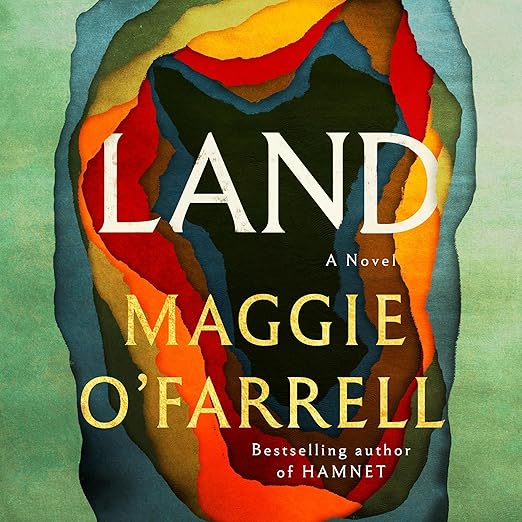
Land
Land ~ Maggie O’Farrell
When Tomás and his son, Liam, come across a hidden spring in a small copse in western Ireland, Tomás decides that he will no longer work for the Redcoats, and instead the maps he creates will be real and true, though this will mean the loss of the only income the family has.
Tomás is a cartographer in mid 19th century Ireland, and has survived the Great Hunger that killed so many, and sent others to the New World in search of a better life. He is a quiet, sometimes hard man, though his childhood in a Dickensian workhouse softens the reader up a bit to him.
Land is not solely Tomás’s story. Liam resists his father’s efforts to draw him into cartography, instead dreaming of the priesthood. Seraphina, Tomás’s wife and fellow workhouse survivor, is the heart of the family. Practical and determined to secure some financial stability, she insists on such “outrageous” necessities as a roof and floor before moving into the dilapidated house Tomás rents. Daughter Enda is a musician who resents that she cannot continue her schooling when the family moves from Dublin. She dreams of more from her life than the monotony of housework. Rose is happier at home, though she would perhaps like to not have been left at home to do everything. The youngest child, Eugene, is nonverbal and deeply attuned to the world around him.
O’Farrell is such a gorgeous, cinematic writer. Her descriptions are rich, lush, and almost fragrant. I was so immersed in her language that I was a bit surprised to find that at the end of the book, I came away feeling slightly dissatisfied. The final section was amazing, but there was something missing for me. I’m not sure if I wanted more from the book, or perhaps less. I liked it a lot, but I didn’t love it. Recommended.
2 Comments
StephLove
I loved Hamnet so much I am almost afraid to read more from this author, in case it’s not as good.
nance
We’ve chatted about this book already, but I want to add that I agree with your assessment: the book made me feel almost ambivalent about most of the characters because I felt that the author spent too much time fortifying the history, legends, and innate draw of the land. True, the title of the book IS “Land”, but I think it would have benefitted from some/a lot of editing. She focused so much on that one, little copse (which seemed a bit too precious to me), that I found myself getting irritated. Almost beaten over the head with it.
Still, her talents as a writer cannot be overstated–her use of language is gorgeous and painterly. But like Steph, above, I will always view “Hamnet” as the gold standard for O’Farrell, and “Land” feels like a denouement. It did not find a place on my Favourites Shelf.