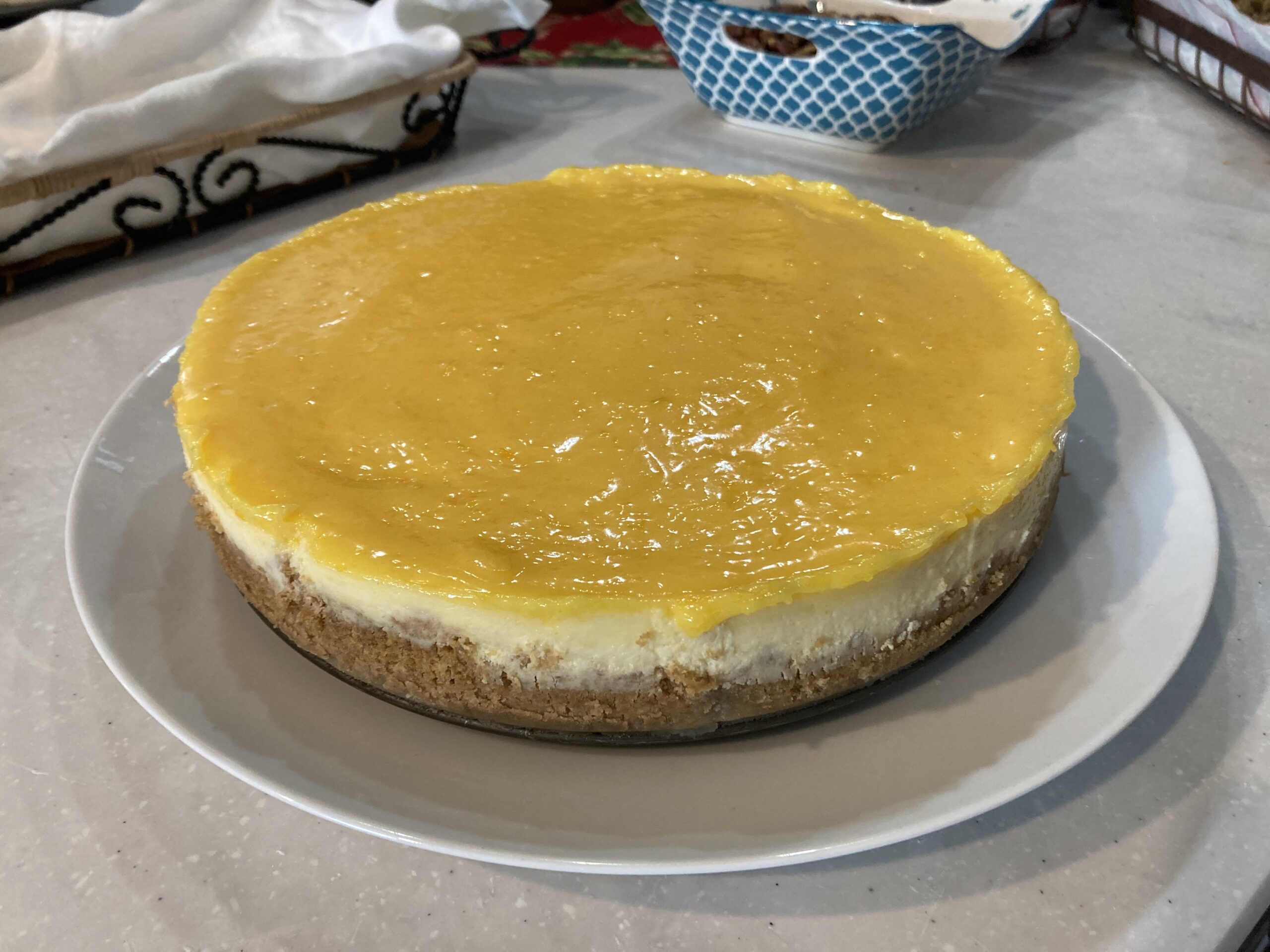
Meyer Lemon Cheesecake
When life gives you Meyer lemons just before a holiday, you don’t make lemonade, you make Meyer Lemon Cheesecake. I’ve done this before, and that time I just made cheesecake and topped it with Meyer lemon curd. Was it good? Yes. But I wondered if it might be better with lemon flavor in the actual cheesecake, and thankfully, the answer is YES. This was my main contribution to our Christmas dinner this year. I found the recipe here, and the notes say that it’s fine to substitute Meyer lemon zest/juice/curd, no alterations needed. A Meyer lemon is a mix between a traditional lemon and a clementine tangerine, so they are sweeter, but not sweet. I love them, and thankfully there are several trees in our neighborhood.
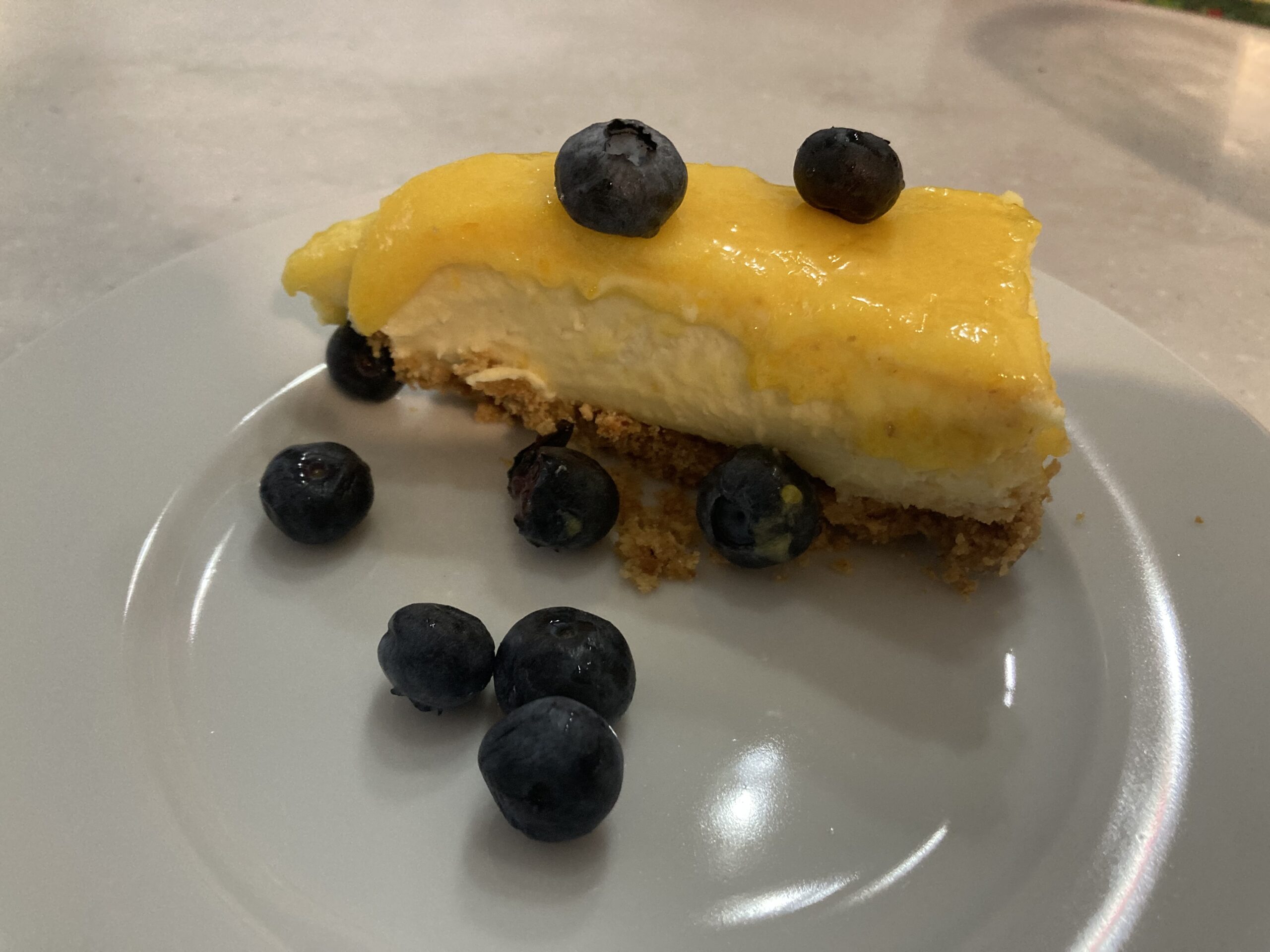
The recipe said to use about 1/2 of the lemon curd, but clearly I went overboard, and I used it all. Also, I did not clean my knife in between slices, so it’s not that neat. Doesn’t matter, it was delicious. I had a piece on Christmas, and then 2 more on Boxing Day. So good. If we had any in our fridge, I’d eat it right now. Here’s your recipe.
The key to a really good, creamy cheesecake is to make sure all of the ingredients are room temperature. I set out most of my ingredients a couple of hours ahead of time, but forgot to set the eggs out. I set them in a bowl of warm water to warm them up a bit. The recipe gets this point home by saying, ‘at room temperature’ after each ingredient. I left that for you, to really drill the point home.
Meyer Lemon Cheesecake
Ingredients
Graham Cracker Crust
- 1 and 3/4 cups (210g) graham cracker crumbs (about 14 full-sheet graham crackers)
- 5 Tablespoons (71g) unsalted butter, melted
- 1/4 cup (50g) granulated sugar
Cheesecake
- 1 and 1/4 cups (250g) granulated sugar
- 1 Tablespoon packed Meyer lemon zest (Meyer lemons have very thin peels, so this was several lemons, maybe 3 or 4, where the original recipe says zest of 1 lemon)
- 32 ounces (904g) full-fat brick cream cheese, softened to room temperature
- 1/2 cup (120ml) fresh lemon juice (about 3-4 lemons), at room temperature
- 1/3 cup (80g) sour cream, at room temperature
- 1 teaspoon pure vanilla extract
- 3 large eggs, at room temperature
Instructions
Adjust the oven rack to the lower-middle position and preheat oven to 350°F (177°C).
Make the crust: If you’re starting out with full graham crackers, use a food processor or blender to grind them into fine crumbs. Pour into a medium bowl and stir in sugar until combined, and then stir in the melted butter. Mixture will be sandy. Press firmly into the bottom and slightly up the sides of an ungreased 9-inch springform pan. Pat down until the mixture is no longer crumby/crumbly; you can use the flat bottom of a small measuring cup to help smooth it out if needed. Pre-bake for 10 minutes. Remove from the oven and place the hot pan on a large piece of aluminum foil. The foil will wrap around the pan for the water bath in step 6. Allow crust to slightly cool as you prepare the filling.
Make the lemon sugar: Place sugar in your food processor or blender. Spoon lemon zest on top. Pulse/blend until the two are blended and the lemon zest is slightly broken down, about 10-12 pulses.
Continue with the filling: Using a handheld or stand mixer fitted with a paddle attachment, beat the cream cheese and lemon sugar together on medium-high speed in a large bowl until the mixture is smooth and creamy, about 2 minutes. (I do not have a stand mixture, I just used my food processor and it worked great.) Add the lemon juice, sour cream, and vanilla extract, then beat on medium-high speed until fully combined. On medium speed, add the eggs one at a time, beating after each addition until just blended. After the final egg is incorporated into the batter, stop mixing. To help prevent the cheesecake from deflating and cracking as it cools, avoid over-mixing the batter.
Pour cheesecake batter into warm crust. Use a rubber spatula or spoon to smooth it into an even layer.
Prepare the simple water bath: Boil a kettle/pot of water. You need 1 inch of water in your roasting pan for the water bath, so make sure you boil enough. I use an entire kettle of hot water. Place the pan inside of a large roasting pan. Carefully pour the hot water inside of the pan and place in the oven. (Or you can place the roasting pan in the oven first, then pour the hot water in. Whichever is easier for you.)
Once the cheesecake is in the oven, make your lemon curd (recipe below). It needs to cool to room temperature before putting on fully cooled cheesecake.
Bake cheesecake for 55–70 minutes or until the center is almost set. (Note: if you notice the cheesecake browning too quickly on top, tent it with aluminum foil halfway through baking.) When it’s done, the center of the cheesecake will slightly wobble if you gently tap the pan. Turn the oven off and open the oven door slightly. Let the cheesecake sit in the oven in the water bath as it cools down for 1 hour.
Remove from the oven, lift out of the water bath, then cool uncovered cheesecake completely at room temperature.
Top with lemon curd: After cheesecake has cooled completely at room temperature, spread about 3/4 cup of lemon curd (around 1/2 of the curd recipe) on top, nearing the edge of the cheesecake without spilling over. I use an offset spatula to spread.
Refrigerate the cheesecake for at least 4 hours or overnight.
Use a knife to loosen the chilled cheesecake from the rim of the springform pan, then remove the rim. Using a clean sharp knife, cut into slices for serving. For neat slices, wipe the knife clean and dip into warm water between each slice.
Cover and store leftover cheesecake in the refrigerator for up to 5 days.
Meyer Lemon Curd
Ingredients
- 4 large egg yolks
- 2/3 cup (134g) granulated sugar
- 1 Tablespoon Meyer lemon zest
- 1/3 cup (80ml) fresh Meyer lemon juice (about 2–3 lemons)
- 1/8 teaspoon salt
- 6 Tablespoons (85g) unsalted butter, softened to room temperature and cut into 6 pieces
Instructions
Fill the bottom pot of your double boiler with 1–2 inches of water. (Or use the DIY double boiler method listed in the notes.) Place on high heat. Once the water begins to boil, reduce to low heat to keep the water at a simmer.
Place egg yolks, granulated sugar, lemon zest, lemon juice, and salt into the top pot of your double boiler. Using a silicone whisk, whisk until completely blended, then continue to whisk as the curd cooks. Constant whisking prevents the egg yolks from curdling. Whisk and cook until the mixture becomes thick, resembling the texture of hollandaise sauce, about 10 minutes. If you’d like to be precise and use a candy or instant-read thermometer, the temperature will rise to about 170°F (77°C). If curd isn’t thickening, turn up the heat and constantly whisk.
Remove pan from heat. Whisk the sliced butter into the curd. The butter will melt from the heat of the curd as you whisk. Pour curd into a jar or bowl and place a piece of plastic wrap directly on top so it is touching the top of the curd. (This prevents a skin from forming on top.) The curd will continue to thicken as it cools. Once cool, the plastic wrap can be removed.
Refrigerate the curd for up to about 10 days.
Tip: Use a glass (heatproof) bowl for your double boiler, and a silicone whisk if you have one. A metal bowl and/or whisk can make the curd taste metallic. Do not let the water touch the bottom of the bowl, you might get scrambled eggs. I didn’t have a perfect setup, but sat an old school Corning ware baking dish over a small pot of boiling water. Since the baking dish didn’t fit inside the pot at all, it took a little longer to really heat up, and I had to raise the heat a bit, but eventually it worked and was delicious. Recipe found here.

28 Comments
AC
I love cheesecake but I don’t think I have had any for a long time. Can you spare a piece for a poor, deprived senior? ?
J
Come on by!
PocoBrat
O wow, this for sure is a labor of love and it looks ABSOLUTELY amazing, J!
Did anyone faint from euphoria after their first taste?
J
I definitely fainted, it was perfect. It’s a lot of work though, not something I would make all of the time, which is a good thing.
San
Oh this sounds so absolutely, positively delicious! I love all things “lemon”, and I will never say no to cheesecake! Thanks for sharing the recipe!
J
I think you would love it, it was really good.
Ernie
Silly me, I was thinking a Meyer lemon was a lemon bought at Meyer (as in the grocery store but I’m not even sure if you have those in CA). I am here for you becoming a prof recipe blogger. This does look yummy and I do not doubt that if it was in my fridge I would also eat a piece or two. Thanks for sharing.
J
We don’t have Fred Meyer here, though they have them in Alaska and Portland, so I’ve definitely been there. Is that the store you mean? It was a really good cheesecake.
Allison McCaskill
Lemon curd cheesecake is my favourite cake. I didn’t discover this until a few years ago at book club dinner in June when I agreed to split a piece with another woman in book club and then I was so bitter I had to share it I felt like stabbing her hand with my fork. I get one for my birthday now and then – really I should every year. Maybe I’m just too afraid I’ll eat the whole thing or there won’t be enough people, because I cannot be trusted around it.
J
I’m right there with you. I had to leave the rest of it with my in-laws, because otherwise I would have eaten it all.
DB Stewart
Cheesecake should be a synonym for happiness, shouldn’t it?
J
Yes, Cheesecake = Happiness!
Suzanne
This is so exactly my jam. YUM.
J
ME TOO!
nance
I’d have just eaten all the lemon curd with a spoon at home and taken the cheesecake for guests with a nice selection of berries for garnish. Lemon curd is the Food Of Goddesses.
Did you bother to use unsalted butter? I never, ever do–I only buy salted–and it never seems to matter.
J
I only buy unsalted butter, but I like salted butter on toast and so on.
The cheesecake with just berries would have been really nice too, but better with the lemon curd. If you were here, I would make a double batch of the curd, and you could eat it however you wanted…on ice cream? On toast? By itself with a spoon?
StephLove
That sounds (and looks) amazing.
J
Thank you! It was really good.
Elisabeth
I have yet to meet a cheesecake I didn’t LOVE. And this one looks delicious.
I swear you could have a restaurant, Julie. Everything you produce looks next-level amazing!
J
Awe, thanks Elisabeth!
Margaret
I love cheesecake but am not too fond of lemon flavored desserts. I like the way you describe a Meyer lemon though, so I might like that flavor. I’ve been eating way too many Xmas cookies lately and not walking enough. Ugh. I refuse to make a resolution for 2026 but will definitely make more effort to get walking.
J
If you don’t like lemon, this is not the dessert for you. It’s not as tart as a regular lemon, but it’s definitely lemon.
I’m with you on the not making resolutions, but still needing to make changes.
NGS
This looks far too complicated for me! LOL. The most ambition I have in the Christmas is to mix everything in a mixing bowl and make cookies.
J
It was defnitely a little complicated, and not something I would make all of the time. That’s a good thing, I think!
Joyce
We stayed at an airbnb that had a huge tree just full of them, with the owners telling us to have as many as we wanted. We opted to make vodka lemon spritzers (or whatever my husband called it). He made lemon simple syrup and we had vodka with it. It was marvelous
J
That sounds really good!
Tobia | craftaliciousme
it looks very tasty. I am lazy and wouldn’t want to make one but I do take a piece.
J
I’m pretty lazy too, and would not make it except for a special occasion. Christmas seemed like a perfect time!