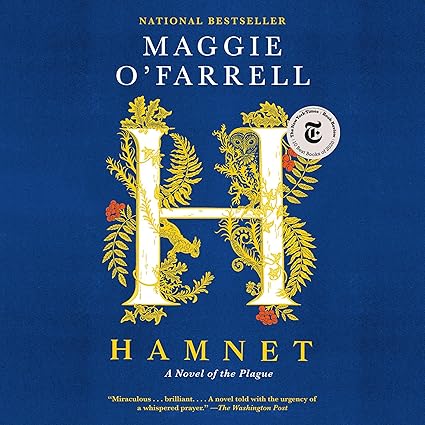
Hamnet
Hamnet ~ Maggie O’Farrell
In the 1580s, a couple living on Henley Street, Stratford, had three children: Susanna, then Hamnet and Judith, who were twins.
The boy, Hamnet, died in 1596, aged eleven.
Four years or so later, the father wrote a play called Hamlet.
This is the basis of Maggie O’Farrell’s gorgeous novel, Hamnet. I read Hamnet a few years ago, and I liked it OK, but I felt like I was really missing something. This was definitely a me problem, but I didn’t connect with it the way I wanted to. I think I had two issues with it. 1. I kept expecting the book to be more about William Shakespeare, and for him to be named and his fame to be an important aspect of the story. So I spent a lot of time waiting for something that did not happen. Wasted energy on my part. 2. I am a terrible reader of physical books. This has not always been true, it is not always true now, but I do most of my physical book reading in bed. Reading horizontally, especially in bed, means I tend to drift off after a few pages (sometimes a few paragraphs). This treatment works surprisingly well for some books, and not at all for others. It worked OK for Hamnet, I followed the story, but the writing here is so gorgeous, it deserves better. I thought I might do better with it if I listened to the audiobook. This worked so well for me, I LOVED it this time. LOVED. The truly intricate details of things the characters were thinking and noticing gave it so much depth.
Hamnet goes back and forth in time…it starts with Hamnet looking for help for his ill sister, and then gives us a glimpse of the romance between their parents, of how they fell in love when he was tutoring her half brothers, how they managed a marriage that her step-mother opposed.
Agnes, mother of Hamnet, is such a rich, fascinating character. As imagined by O’Farrell, she is a woman of nature. She heals people in the village with herbs and tinctures. She gives birth in the woods, alone. She spends time in her garden and in the woods, she can tell a lot about a person by holding their hand in a particular way, she has visions.
Think of this scene…Agnes and her groom are walking to church to be married. She is missing her mother, who died when she was a young girl. O’Farrell could have said, “Agnes is wishing that her mother were here. She senses her presence still.” Instead, she gives us the lush description that tells so much more.
“She senses, too, somewhere off to the left, her own mother. She would be here with her had life taken a different turn. She would be the one holding her hand as Agnes walked to her wedding, her fingers encasing her daughter’s. Her footsteps would have followed her beat. They would be walking this path together, side by side. It would have been her making the crown, affixing it to Agnes’s head, brushing the hair so that it hung all around her. She would have taken the blue ribbons and wound them around her stockings, woven them into the hanks of her hair. It would have been her.
So it follows, of course, that she will be here now, in whatever form she can manage. Agnes does not need to turn her head, does not want to frighten her away. It is enough to know that she is there, manifest, hovering, insubstantial. I see you, she thinks. I know you are here.”
She falls in love with her husband because of his complicated, amazing brain, which she sees long before anyone else. His father is a disgraced glove maker, and no one really thinks much of his prospects in town. Agnes sees that living under his father’s roof is slowly killing him, and suggests that perhaps he could expand the family business by selling gloves in London. She has never left her village.
Hamnet and Judith (the book was released under this title in Canada) are obviously not identical twins, but they are very similar looking, and are very close, best friends, they each feel like they are one person. When they are born prematurely, Hamnet is healthy, Judith is much more frail. Agnes watches over her carefully, takes close care to ensure she stays healthy. When Judith falls ill, Agnes works furiously to save her. Hamnet catches the illness and dies.
The writing is so evocative, so gorgeous. So heartbreaking. The grief of the family is so palpable, it broke my heart.
”Agnes is a woman broken into pieces, crumbled and scattered around. She would not be surprised to look down, one of these days, and see a foot over in the corner, an arm left on the ground, a hand dropped on the floor. Her daughters are the same. Susanna’s face is set, her brows lowered in something like anger. Judith just cries, on and on, silently; the tears leak from her and will, it seems, never stop.
How were they to know that Hamnet was the pin holding them together? That without him they would all fragment and fall apart, like a cup shattered on the floor?
The husband, the father, paces the room downstairs, that first night, and the one after. Agnes hears him from the bedroom upstairs. There is no other sound. No crying, no sobbing, no sighing. Just the scuff-thud, scuff-thud of his restless feet, walking, walking, walking, like someone trying to find their way back to a place for which they have lost the map.”
I loved this book so much. When I saw the gorgeous film adaptation, I thought I liked that more. Now that I have listened to the audiobook, I have changed my mind. We’ll see if I change it back, the DVD release is set for March 3, and I want to add it to my video library. Highly recommended.


30 Comments
Lisa's Yarns
I feel sheepish admitting this, but I did not like Hamnet. It should have worked for me but it just didn’t for some reason. I had zero familiarity with Hamlet (or most of Shakespeare’s works – I think I’ve only read Romeo & Juliet). So maybe that is part of why it didn’t work for me? I know it was beautifully written and such a beloved book by many, though! And I do want to see the adaptation at some point.
J
I don’t think you need to know the plot of Hamlet at all for the book to work. Everything that is important in that scene is said in the novel. You are not alone in not loving Hamnet, and as I said, I didn’t love it either the first time. I might not have tried again had I not loved the film SO MUCH. I’m really glad that I gave it another go, the audiobook really worked for me. Perhaps you’ll be motivated to listen to it after you see the film. But you know, there are a lot of great books out there. No need to feel badly if it didn’t work for you. I know several people who feel the same way.
NGS
Don’t feel sheepish, Lisa! I’ve been over here talking about how much I don’t like Hamnet for YEARS (I guess I read it in 2022). So melodramatic. HOWEVER. The scene about the plague and the flea and the beads was SO GOOD that it maybe makes up for the violent depictions of domestic violence? Maybe?
J
The domestic violence at the hands of Agnes’ FIL was a lot. Was there more that I glazed over? Now I’m trying to remember if they included much about it in the film…
Elisabeth
The book was beautifully written but SO depressing that it ended up being a DNF for me. I have a little bit of FOMO because it’s beloved by so many, but at least at the time I was reading it I just found it too heartwrenching.
J
It was really sad, but she gave it some peace at the end, which I found hopeful.
Daria
I am still reading the book and watched the movie last weekend. Should I give the book up since I watched the movie? I am 40% in…
I like the book but feel like now I know what happened?
That MOVIE- both Tony and I cried our eyes out. I don’t do well with movies about loss, especially the loss of children. But I liked the two main characters. Especially, Agnes.
J
Wasn’t Jessie Buckley amazing as Agnes? Stunning. Should you finish…are you enjoying it? You could think of it as a reread.
Margaret
I didn’t love the book as much as most of my Book Club did…until the end.
J
The end was beautiful, wasn’t it?
Suzanne
What a fabulous review, Julie. I adored The Marriage Portrait so much that I bought a hard copy for myself (I listened to it via audiobook) and swore that I would read everything O’Farrell has written. But… I have not done so yet. Hamnet never really appealed to me because I am not a big Shakespeare fan, but it seems like that doesn’t have to be a prerequisite to reading and enjoying this book!
J
You absolutely do not need to know anything about Hamlet the play, nor about Shakespeare in general, to get this book. All you need to know is that Hamlet’s father has died, and he is grieving the loss, which she spells out in the book. I think that my knowledge of the play actually hampered my enjoyment the first time I read it, because I was looking for parallels that were not there. I hope you give it a try! The narrator for the audio version is perfection.
Now I’m going to have to listen to The Marriage Portrait!
Allison McCaskill
I loved Hamnet and Judith. Sometimes this kind of writing doesn’t work as well for me – the intricate details, the meandering paragraphs – but I was exactly in the mood for it. I loved the description of Agnes and Will’s relationship, I loved the way the setting was lovingly described, I loved the way the children were with each other. I haven’t seen the movie yet, but I love Jessie Buckley and am looking forward to it.
J
Yes to all of this. And perhaps the writing style, which I loved this time, was not hitting me right the first time I read it.
DB Stewart
Your review made me think about this (fantastic) book differently. As did the film. I thought of this book as a love story, a complicated, painful love story. Your review emphasizes a theme I realize now is central: the healing power of women, but moreover the weighty burden of that power. I hope this makes sense.
J
That’s an interesting perspective, and yes, I see that too, and it does make sense. Also a sad, complicated love story though.
nance
Wonderful review, J. This book is one of the most beautifully written that I have ever read. I was very reluctant to let it go when I finished it.
J
It really was lovely, wasn’t it?
StephLove
I loved this book. It was so immersive.
J
Immersive is exactly right!
ernie
I agree with Nance. I found this book so beautifully written, I was sad when I was finished with it. I loved the movie too. I thought they did an excellent job and so often I find myself saying The Book Was Better. I still think the book was better, but that’s just because it was practically poetic. I loved the movie too.
J
Yes, I thought the movie was better until I went back and reread the book. SO GOOD.
Nicole MacPherson
I’ve been meaning to read this for so long! I love this author so I don’t know WHY I haven’t yet. Thanks for the gentle nudge!
J
I hope you love it as much as I did!
PocoBrat
How lovely that you came back for a reread and that it landed for you this time!
I liked her _The Marriage Portrait_ too (and would love to discuss the ending).
J
That’s on my list! I hope I get it soon.
Diane
I love this book so much that I don’t even want to see the movie.
The ending – so perfect, left me breathless.
J
I think if you change your mind regarding the film, you will be pleasantly surprised.
Jenny
I haven’t read anything by Maggie O’Farrell, but I feel like I should! This sounds like something I would like.
J
I hope you love it Jenny!