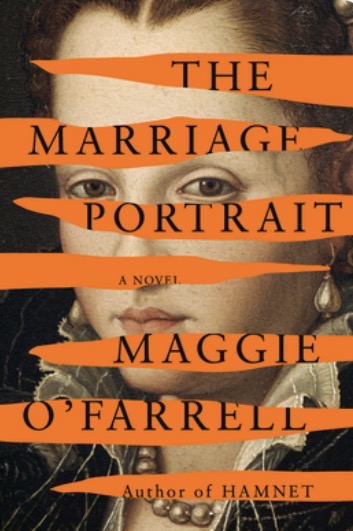
The Marriage Portrait
The Marriage Portrait ~ Maggie O’Farrell
Lucrezia de’ Medici is betrothed at 13 to her recently deceased sister’s fiancé, though they wait to marry until she is 15. Now she is a duchess, living in Ferrara, far from her family and her home. As the book begins, Lucrezia, now 16, has the distinct feeling that her husband, Alfonso, intends to have her killed. From here we go back and forth through their relationship. From their first meeting, when he was courting her sister and appears to be charming and kind, to the news that she is to be married to him (in her sister’s wedding dress), though she begs her father not to make this match.
Alfonso is described at one point of being like Janus, the Roman god of duality, and this description fits. He can be charming, gentle, and kind, as well as controlling, cruel, and ruthless*. He is 12 or 13 years older than Lucrezia, and has no illegitimate children, which should be worrying in this time and place, especially if you are the person considered to be responsible for providing an heir to the title.
O’Farrell’s use of language is gorgeous, and mostly I loved this book. I loved the internal life that Lucrezia leads, loved the descriptions and her personality. The ending fell a little flat for me, and I did not love it nearly as much as I loved Hamnet, but that is an extremely high bar. Highly recommended.
*Did I read this on one of your blogs? That ‘ruth’ is also an adjective? I mean, it makes sense, but I’ve only heard it as a name, not in describing a person.


20 Comments
Nicole MacPherson
I loved the book EXCEPT for the ending. The ending was SO dumb. I found my review of it, and I’ve copied it for you (March 2023)
I had put this on hold, but unsurely; historical fiction is a tricky genre for me as I feel it is so hard to do it well. Often I find that modern values will be placed in historical fiction, to the detriment of the plot, and the dialogue can feel very off. Also, there was a lot of buzz about this book and that doesn’t always translate to me to be an enjoyable read. I mean, sometimes it does, but often I am disappointed. I read the jacket before starting the book and two things stood out: I had read and enjoyed this author’s memoir about her multiple brushes with death, and The Marriage Portrait was an imagining of the life of the subject of the portrait in Robert Browning’s My Last Duchess. I, along with everyone else, probably, read and dissected this poem in university; I really liked it and at that moment, I was in. I did enjoy this book about a young Florentine woman married off to the Duke of Ferrara; and some of it was a little heavy-handed with the imagery, and I quibble with the ending, but for the most part it was a sweeping story that really hooked me in. I was in the perfect mental space to be transported by this novel.
J
I feel exactly the same way. Amazing book, dumb ending. Thank you for copying your review here!
I had not read the poem, and had no knowledge of the real life people going in, so it was interesting to read a bit after.
StephLove
I think ruth means mercy (thus ruthless).
I loved Hamnet, but haven’t read this one.
J
Yes, I think you’re right! Mercy = Ruth.
Hamnet was magic.
nance
I read this some time ago, and my feelings are pretty much the same as yours. Hamnet is a hard act to follow–I read that first. O’Farrell’s writing and adept descriptions kept me enthralled. It was a book I was glad to read (and keep in my library).
J
Yes, I need to own Hamnet (and I do), but I don’t need to own The Marriage Portrait, mostly because of the ending. Otherwise it was so beautiful, she is such an amazing writer.
Margaret
I thought this book was much weaker and less interesting than “Hamnet” and didn’t care for the ending either. Very unlikely.
J
Another no vote for the ending!
Jamie
Outlier here: I love the ending!
J
I’m glad to hear that someone did!
Common Household Mom
I read “The Marriage Portrait” in 2023. Maggie O’Farrell writing is top-notch and enabled me to finish the book, which I was reading for book club. Sadly, the treatment of women in the book seemed to me to be vividly relevant to our own time. (I could not finish “Hamnet”, despite the exquisite writing, because of the subject matter.)
J
Is it the plague aspect that made you not able to finish it, or the death of their child? It was definitely heartbreaking.
DB Stewart
Can’t wait to read this; I found Hamnet hard to put down.
Ruth is a noun actually, but yes…a precise word that should be more common.
https://thinkstew-dbs.blogspot.com/2026/02/a-quick-reminder.html
J
It was your place where I learned this! And I guess I thought it was an adjective because I was thinking of someone being ruthless.
Suzanne
I *adored* The Marriage Portrait, and yet I cannot remember the ending AT ALL?!?! Probably means it was dumb.
J
LOL, the writing was wonderful. I just didn’t enjoy the ending.
Jenny
I haven’t read this, or any of her books (I know! What is wrong with me?) The plot sounds really interesting, but I’m put off by the potential dumb ending. Maybe I should just read Hamnet.
J
This book was lovely, but Hamnet is gorgeous. I mean, unless you are one of the folks that didn’t like Hamnet, but I think you would.
ernie
Oh, this sounds interesting. Bummer the ending seems to not land as that’s the consensus here. I love Hamnet and count it as one of my fav books of all time, which makes me stop and wonder why I’ve not read any other of O’Farrell’s books. I plan to remedy that this summer.
J
Ernie, she has a new book coming out soon! June 2nd, the book is called ‘Land’, and is about the Great Hunger in Ireland. Exciting!